- Home
- Product Categories
- Sensors
- Capacitive Touch Sensor IC (Sale)


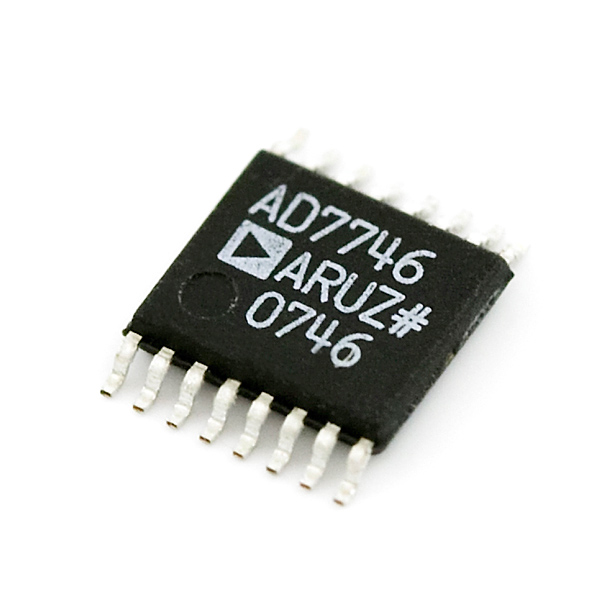
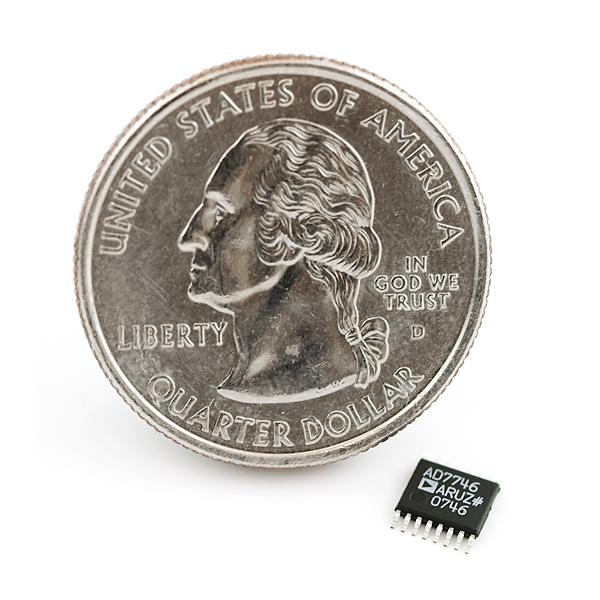

Capacitive Touch Sensor IC (Sale)
Replacement: None. We don't carry a direct replacement for this sensor, but check out our capacitive sensor category. This page is for reference only.
Capacitance is an amazingly accurate way to measure everything from physical contact to length or pressure. While capacitance sensors typically require a fair amount of circuitry, we now have one in a single IC with an I2C digital interface. Make tactile switches obsolete!
- Accuracy: 4 fF (yes femto)
- Linearity: 0.01%
- Common-mode (not changing) capacitance up to 17 pF
- Full-scale (changing) capacitance range: ±4 pF
- Tolerant of parasitic capacitance to ground up to 60 pF
- Update rate: 10 Hz to 90 Hz
- Simultaneous 50 Hz and 60 Hz rejection at 16 Hz
- Temperature sensor on-chip
Resolution: 0.1°C, accuracy: ±2°C - Voltage input channel
- Internal clock oscillator
- 2-wire serial interface (I2C®-compatible)
- Power
2.7 V to 5.25 V single-supply operation
0.7 mA current consumption - Operating temperature: –40°C to +125°C
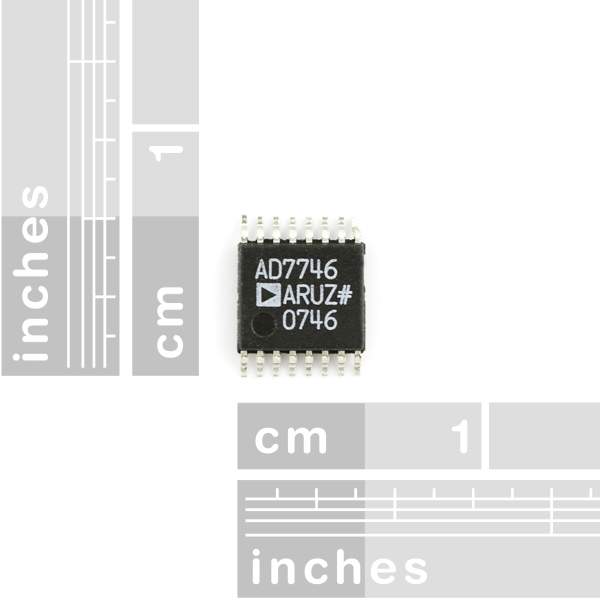
- 16-lead TSSOP package
Comments
Looking for answers to technical questions?
We welcome your comments and suggestions below. However, if you are looking for solutions to technical questions please see our Technical Assistance page.
Customer Reviews
No reviews yet.
In case anyone else wonders how many buttons they can hook up directly to this, the datasheet claims that the AD7746 is a two channel chip.
Please contact me via email when this item comes in.
If you click the "Autonotify" button to the right of the product description, just below the price info and "Add to Wish List", you can register for an automatic e-mail notification when we restock the item.
Interesting... could this be used to make a bathroom scale? Just touch a button and calibrate the capacitance to the mass/volume/shape of the person. Does this determine both the total amount the capacitor charged up AND the rate it charge up?
Can this be used for a capitative touch screen?
Difficulties in building a capacitive touchscreen
Building a capacitive touchscreen would be analogous to making your own LCD - It requires manufacturing processes you probably don't have, and requires several hundred IO pins. This is not analogous to an LCD controller - It's more like an LED driver with which you can build a 7-segment display.
A real capacitive touchscreen has rows and columns which are perpendicular on opposite sides of an electrode substrate (usually glass for a touch-SCREEN-, but possibly PCB material, flex PCB, or a plastic film for an opaque input device). The controller scans each the rows and columns, measuring the capacitance between each pair. A change in capacitance indicates the presence of a finger or stylus at the intersection of the row and column. This requires a lot of electrodes on the glass, a lot of pins on the IC (Far more than 16!), and a fast interface over which to report the data. These processes are usually restricted to high-volume manufacturers, so the chips and datasheets are usually similarly restricted.
What you'd get on a touchscreen project with this part
You could simulate a very low resolution capacitive touchscreen with this part. This one only has two channels, so you could get a 2 pixel grid.
The MPR121QR2 has more channels. Its breakout board has 12 buttons on a PCB, but by arranging these in a 6x6 or 5x7 pattern, you could get a reasonable approximation of a touchscreen. You'd need the electrodes to be small enough that a finger touched a row and a column simultaneously; that part doesn't do differential row-column scanning.
What is it good for?
This part isn't even a very good button detector. Other parts have many more channels, and more flexible button-press detection mechanisms, slider and grid configuration options, are cheaper, have a higher update rate, and usually support guard traces. However, the awesome thing about this part is it's 24-bit, 4 femto-farad resolution measurement capability.
Other parts don't report this information very well. They focus on processing it for you and provide you with keypress data. The MPR121 provides 10-bit data, stating that "the data range is 0-1024" and not much more. The Atmel Qtouch parts provide 16-bit data, but it's similarly unclear how this can be interpreted to measure capacitance or how accurate it is. The only information on this measurement is This command returns a 2-byte report containing the most recent measured signal for key 'K'. The signal is returned as a 16 bit number, MSB first. The Freescale MPR08x series doesn't give any access to this information at all.
This part includes a 24-bit ADC, with a temperature sensor and voltage reference to make this ADC more accurate. The ADC is exhaustively specified. It doesn't even mention button sensing. If you decide to attempt manufacture of a touchscreen, this would be a great tool to accurately measure the capacitance developed between channels on your prototype. This is a capacitance sensor (and a very good one at that!), but it's not a touchscreen, button, or slider controller.
A BOB for this would be amazing!
This device is very sensitive to parasitic capacitance. To fully utilize its capabilities, you'd place it and the capacitance to be sensed on the same PCB.
Plugging this into a breadboard and connecting it to a capacitance source with some hookup wires would be pointless; you'd end up measuring the capacitance of the breadboard and wires.
If you are comfortable soldering it yourself, Sparkfun sells an SSOP to DIP Adapter Board.