Hookup Guide
 Schematic
 Datasheet (PCA9615)
Product Overview
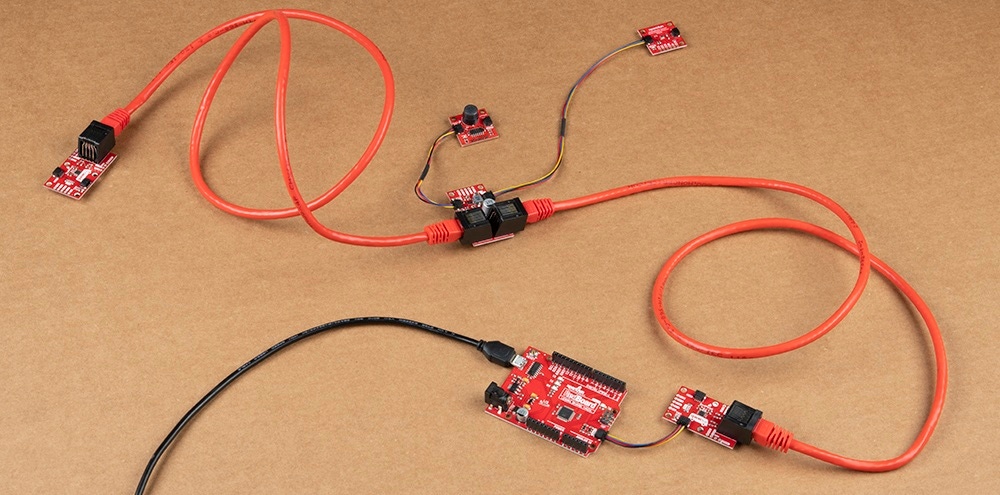
The SparkFun QwiicBus MidPoint works in tandem with the QwiicBus Endpoint so you can tap into a long-range I2C network and drop in sensors exactly where you need them. While extending your I2C bus up to 100 feet is incredibly helpful, you often need to attach sensors at various stops along that path. This breakout board acts as a "middle node" in your QwiicBus network, letting you plug into the main data line with standard Ethernet cables and quickly add devices anywhere along the chain!
Drop-In Sensor Expansion
Like the QwiicBus EndPoint, this node relies on the NXP PCA9615 IC to keep it as simple and easy to use as possible. Instead of forcing you to translate your I2C communication into complex RS-485 or 1-Wire protocols, the system converts the two default I2C signals into four differential signals (two for SCL and two for SDA). To tap into the network, simply plug your Ethernet cables into the dual onboard RJ-45 jacks. From there, you can connect your sensors directly to the two Qwiic connectors without any soldering.
Long-Range Qwiic
Because the MidPoint is fully Qwiic-enabled, you can set up a sensor network in your home or run data lines across an autonomous vehicle with no soldering required! You communicate with the sensors exclusively via I2C, just as you normally would. However, running sensors across longer lengths often causes power loss and voltage drops. To solve this, the MidPoint features a few amenities to help:
- Solderless Connections: Dual Qwiic connectors let you plug directly into your microcontroller and sensor ecosystem.
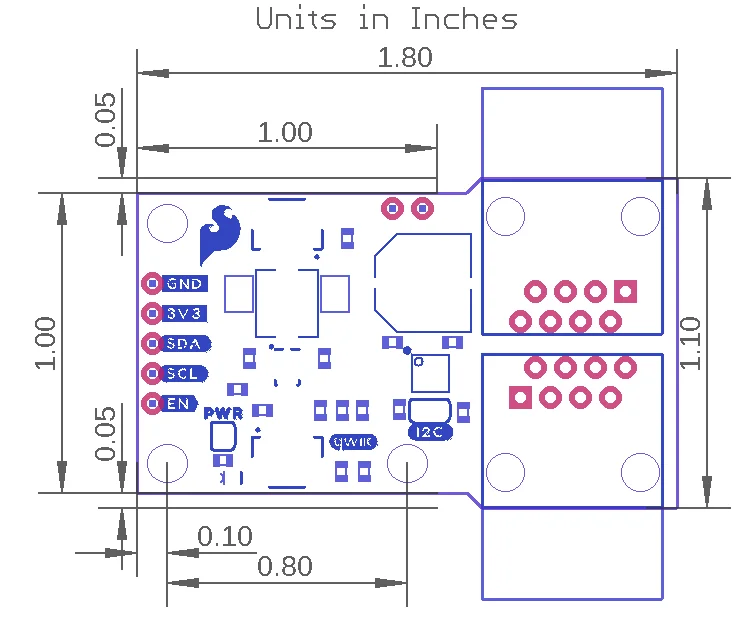
- Breadboard-Friendly: Standard 0.1-inch spaced pins are broken out for users who prefer a traditional setup.
- Extra Power Delivery: When enabled, the built-in LMR33630 buck regulator can source a massive amount of current (up to 3A at 3.3V) to directly power heavy-duty devices attached to the node. The regulator accepts a wide supply voltage range from 3.6V all the way up to 36V.
- Custom Configurations: Supports multiple power configurations depending on your application, with a 2.3-5.5V range for the I2C supply and a 3-5.5V range for the differential supply.
Whether you have a robot with multiple I2C devices throughout it, a sensor network project with multiple sensors over a large area, or other I2C projects you can think of that require a wired signal transmission over long distances, QwiicBus makes that communication a breeze!