This product has shipping restrictions, so it might have limited shipping options or cannot be shipped to the following countries:
Creative Commons images are CC BY 2.0
Description: Using our muscles to control things is the way that most of us are accustomed to doing it. We push buttons, pull levers, move joysticks… but what if we could take the buttons, levers and joysticks out of the equation? This is the MyoWare Muscle Sensor, an Arduino-powered, all-in-one electromyography (EMG) sensor from Advancer Technologies. The MyoWare board acts by measuring the filtered and rectified electrical activity of a muscle; outputting 0-Vs Volts depending the amount of activity in the selected muscle, where Vs signifies the voltage of the power source. It’s that easy: stick on a few electrodes (not included), read the voltage out and flex some muscles!
The MyoWare Muscle Sensor is the latest revision of the Muscle Sensor of old, now with a new wearable design that allows you to attach biomedical sensor pads directly to the board itself getting rid of those pesky cables. This new board also includes a slew of other new features including, single-supply voltage of +3.1V to +5V, RAW EMG output, polarity protected power pins, indicator LEDs, and (finally) an On/Off switch. Additionally, we have developed a few shields (Cable, Power, and Proto) that can attach to the Myoware Muscle Sensor to help increase its versatility and functionality!
Measuring muscle activity by detecting its electric potential, referred to as electromyography (EMG), has traditionally been used for medical research. However, with the advent of ever shrinking yet more powerful microcontrollers and integrated circuits, EMG circuits and sensors have found their way into all kinds of control systems.
Note: Biomedical sensor pads can be found in the Recommended Products section below to be purchased separately.
Get Started with the MyoWare Muscle Sensor Guide
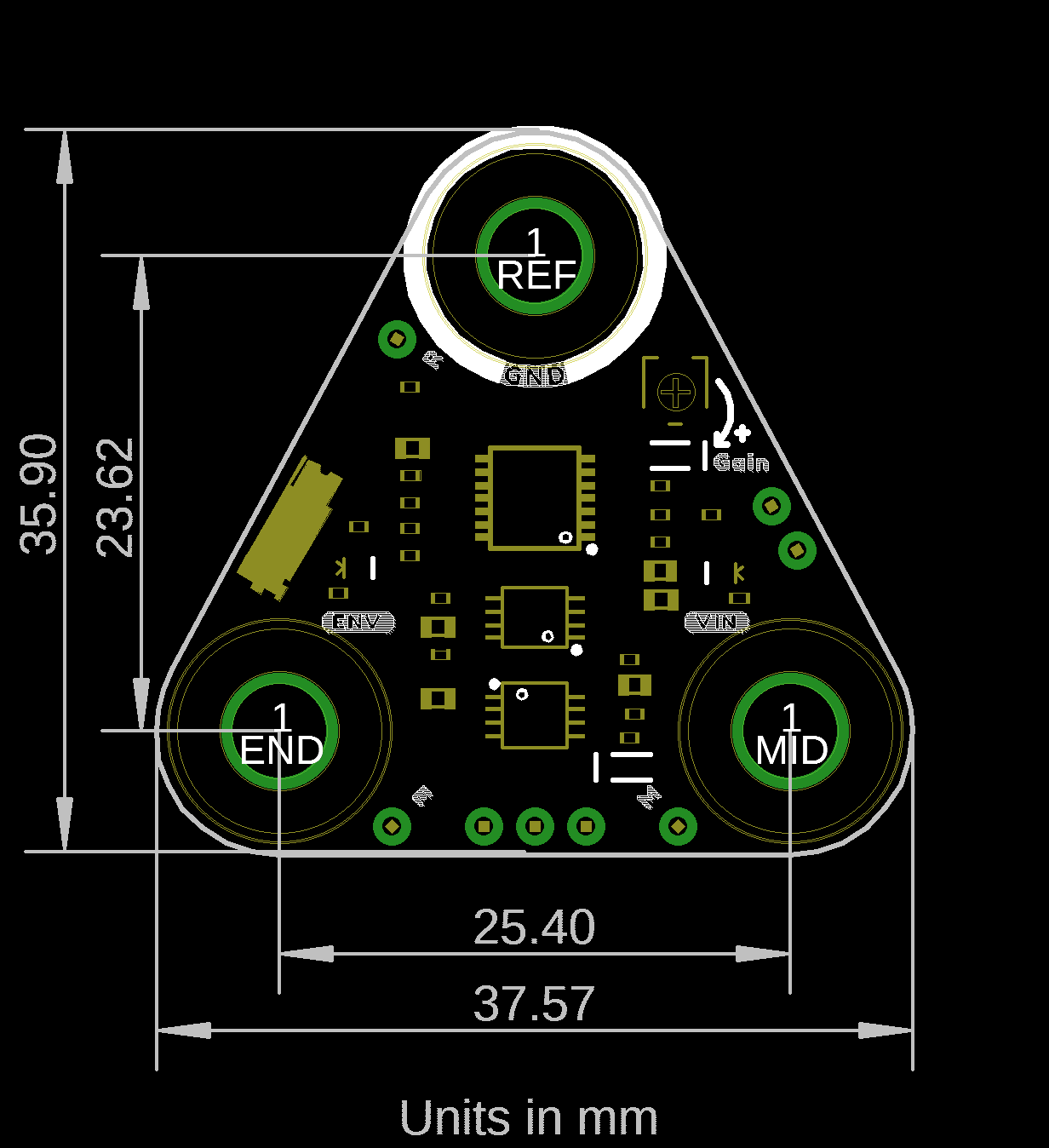
Dimensions: 0.82" x 2.06"
Features:
Documents:
A row of headers - break to fit. 40 pins that can be cut to any size. Used with custom PCBs or general custom headers. **Fea…
Using our muscles to control things is the way that most of us are accustomed to doing it. We push buttons, pull levers, move…
The AD8232 SparkFun Single Lead Heart Rate Monitor is a cost-effective board used to measure the electrical activity of the h…
Heart rate data can be really useful whether you're designing an exercise routine, studying your activity or anxiety levels o…
This is a 10 pack of Biomedical Sensor Pads, disposable electrodes that can be used to measure EEG, ECG and EMG levels. these…
This is your simple three conductor sensor cable with electrode pad leads. These cables are 24" long and feature a 3.5mm audi…
This is the BITalino ( r )evolution Board Kit, a (comparatively) low-cost biomedical data acquisition dev board that allows y…
The MyoWare Muscle Sensor is now designed to be wearable allowing you to attach [biomedical sensor pads](https://www.sparkfun…
The MyoWare LED Shield is designed to pair with the [MyoWare Muscle Sensor](https://www.sparkfun.com/products/13723). The blu…
This is a simple 3 pin female PTH header. This header is in a configuration that makes it ideal to be used with the [MyoWare …
The MyoWare Power Shield is designed to take two standard CR2032 coin cell batteries to power the MyoWare Muscle Sensor. We h…
This is the MyoWare Proto Shield, a simple proto-board for your MyoWare Muscle Sensor. With this shield you will be able to u…
This is the new Arduino Uno R3. In addition to all the features of the previous board, the Uno now uses an ATmega16U2 instead…
It's blue! It's thin! It's the Arduino Pro Mini! SparkFun's minimal design approach to Arduino. This is a 5V Arduino running …
A simple flex sensor 2.2" in length. As the sensor is flexed, the resistance across the sensor increases. Patented technology…
CR2032 Lithium metal 3V 250mAh button cell battery. Great for powering low power processors or blink an LED for weeks at a ti…
The Teensy is a breadboard-friendly development board with loads of features in a, well, teensy package. Each Teensy 3.2 come…
The SparkFun MPU-9250 IMU Breakout features the latest 9-axis MEMS sensor from InvenSense. Each of these 9DoF breakouts featu…
A simple flex sensor 4.5" in length. As the sensor is flexed, the resistance across the sensor increases. Patented technology…
This is a force sensitive resistor with a round, 0.5" diameter, sensing area. This FSR will vary its resistance depending on …
A vibration motor! This itty-bitty, shaftless vibratory motor is perfect for non-audible indicators. Use in any number of app…
This is your tried and true white solderless breadboard. It has 2 power buses, 10 columns, and 30 rows - a total of 400 tie i…
It's blue! It's thin! It's the Arduino Pro Mini! SparkFun's minimal design approach to Arduino. This is a 3.3V Arduino runnin…
Resistors are a good thing, in fact, they're actually crucial in a lot of circuit designs. The only problem seems to be that …
Based on 4 ratings:
2 of 2 found this helpful:
by Member #790956 verified purchaser
Bought the myoware sensor for my class project and it works perfectly
by Member #556548 verified purchaser
It is just the device that we need for our Project.
by Member #712837 verified purchaser
We purchased 6 for a lab class I’m teaching. Only 4 worked well. Other two were totally unreliable.
Kansukee replied on March 16, 2017:
Sorry to hear about the issues with the sensors. Have you reached out to our technical support staff? They can help to troubleshoot your setup and get you replacement sensors for the class. You can reach them at techsupport@sparkfun.com
by Member #900947 verified purchaser
The sensor works almost fine but the attached wire for the reference terminal is not too long enough so we are unable to get the required values accurately. Moreover, there is not provided any manual for specifically this model. We will be thankful to you if you people help us on its REAL TIME DATA acquisition.
Kansukee replied on March 17, 2017:
Hi!
Have you contacted our technical support department over at Techsupport@sparkfun.com ? They can help you to troubleshoot and potentially help you out with your real time data acquisition if you reach out to them.
Forgot your password?
No account? Register one!
I bought this device along with the Myoware Cable Shield and my device is giving me incorrect readings. The red light to say that the “Muscle is contracting” is constantly on! Does anyone know why this is happening?
I am not sure if you have resolved the issue but did you try adjusting the gain? Try looking at my troubleshooting comment here => https://learn.sparkfun.com/tutorials/myoware-muscle-sensor-kit/discuss#comment-58dd3817f3b1a87e608b4568 .
Is the isolation amplifier necessary if the USB port is plugged into a computer that is not connected to the power grid?
The sensor accompanies the Biomedical Sensor Pad?
i bought this kit from one week ago to read subvocal signal (signal from throat ) but it didn’t sense any signal from my throat . any idea,
Customers have used the MyoWare to measure vocal cord activation. You might want to double check your setup. Feel free to email us at support@advancer.co if you need help troubleshooting.
One complaint is that the connector that is supposed to be attached to the user’s bony area is way too short. There is not a good bony area that close to a large muscle (such as the bicep).
The reference electrode can be attached areas other than a bony area. It simply needs to be attached to an area that is adjacent to the muscle you are trying to measure. The function of this electrode is to align the sensor’s ground state with the ground state of the user’s body. Yes, a bony area is ideal because it does not produce electrical signals but it is by no means strictly required. For example, the sensor will work perfectly fine for the bicep if you place it along the inside of the user’s arm between the bicep and tricep.
Do you happen to know what the frequency range is and where the rolloff/cutoff points are set at?
Most of the filtering comes from the high CMRR of the AD8236 which will remove most noise artifacts common to both input electrodes such as the dreaded 50/60Hz electrical “hum”. Other than that there is a high pass filter that is used to remove DC offsets that can be present due to electrode polarization and skin dielectric characteristics. This HPF has a cutoff frequency of 0.33Hz. The EMG envelope output (SIG) has an integration circuit that has a cutoff frequency of 2Hz. (note: the Raw EMG output (RAW) does not go through this portion of the circuitry.)