- Home
- Product Categories
- Other Motors
- Solenoid - 5V (Small)


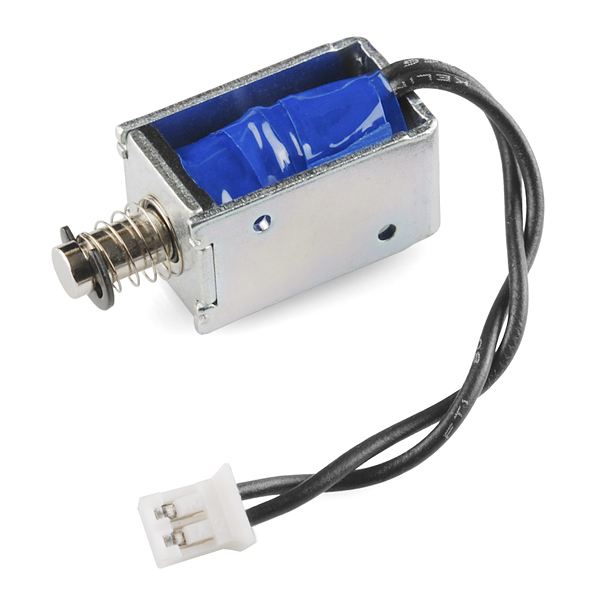
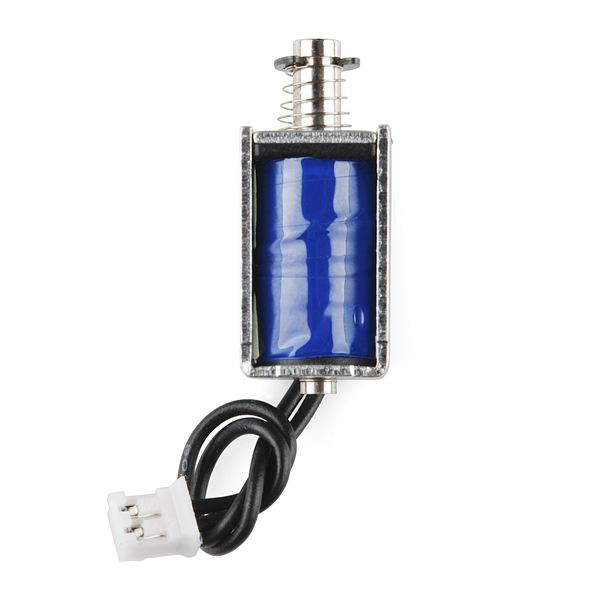
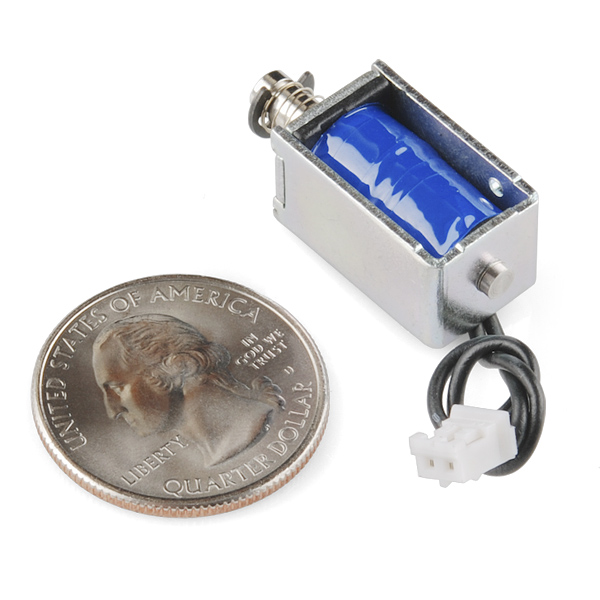

Solenoids are a great way to induce linear motion for pushing, pulling or controlling switches and levers. This smaller solenoid is designed to work directly with 5V which makes it a great match for embedded projects. It has a throw of about 4.5mm and 2 M2 mounting holes on the body.
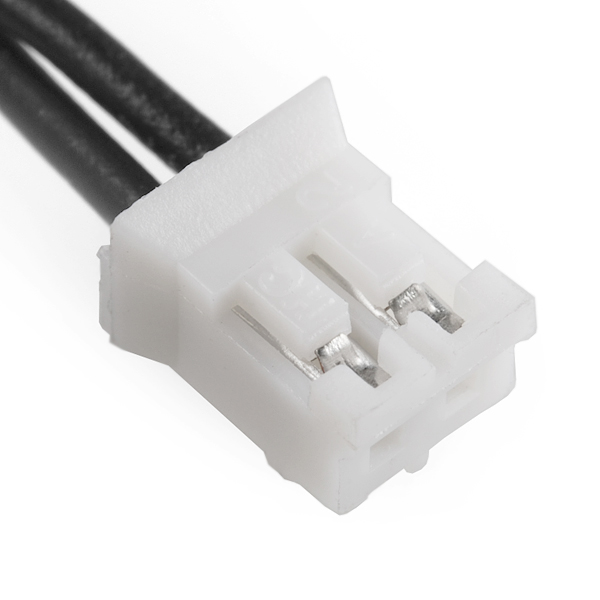
The wire lead is about 2" long and is terminated with a 2-pin JST PH connector.
Note: The mounting holes on this solenoid are actually 1.6mm in diameter. This will allow you to tap for an M2 screw. Also, although the datasheet lists a throw of 6mm, the actual throw appears to be closer to 4.5mm.
Solenoid - 5V (Small) Product Help and Resources
Do not power directly from I/O pins
At 5V, this solenoid can pull up to 700mA of current. In order to control this device using Arduino, you will need a MOSFET. We recommend using our MOSFET Kit to safely control this product.
Resources & Going Further
To control the solenoid from a microcontroller, you'll need to add a flyback diode and a MOSFET/Relay. For more information, check out the application circuit in our diodes tutorial. The solenoid will simply be added as a load on the MOSFET or relay of your choice.
Core Skill: Robotics
This skill concerns mechanical and robotics knowledge. You may need to know how mechanical parts interact, how motors work, or how to use motor drivers and controllers.
Skill Level: Noob - You will be required to put together a robotics kit. Necessary parts are included and steps will be easy to follow. You also might encounter basic robotics components like bearings, mounts, or other hardware and need a general idea of how it goes together.
See all skill levels
Core Skill: Electrical Prototyping
If it requires power, you need to know how much, what all the pins do, and how to hook it up. You may need to reference datasheets, schematics, and know the ins and outs of electronics.
Skill Level: Noob - You don't need to reference a datasheet, but you will need to know basic power requirements.
See all skill levels
Comments
Looking for answers to technical questions?
We welcome your comments and suggestions below. However, if you are looking for solutions to technical questions please see our Technical Assistance page.
Customer Reviews
4.3 out of 5
Based on 23 ratings:
5 of 5 found this helpful:
Nice for little Arduino projects
I used these for my Robotic Glockenspiel project, as the hammers that hit the chimes. They seemed to need 9V (rather than 5V) to operate well, but I'm careful to keep the power dissipation below the rating in the specifications. I removed the snap ring and spring to reduce the noise of operation - letting gravity bring the slug back down after hitting the chime.
I like these solenoids because I can run them from the Arduino 9V Vin (with a 1000uF cap to avoid drawing the power supply down). I use a TIP 120 transistor to control the power to the solenoid.
A few wishes to make it even better for me: tap the holes rather than leaving them untapped, and don't go to the trouble of adding a connector to the solenoid wires.
These have turned out to be nice, inexpensive hobby solenoids I can easily play with. I like them a lot.
1 of 1 found this helpful:
great
compact
1 of 1 found this helpful:
Great little solenoid.
If you give this guy 12v quickly, it's got a great punch to it.
1 of 1 found this helpful:
Just what I needed
I needed a kicking mechanism for the soccer bot I'm building. It had to be small and require only 5 volts, but still be able to propel a ping pong ball several feet. I wasn't sure if this solenoid would do the job, but it turned out that it was just what I needed. The coil draws almost an amp of current (I use three AAA batteries which drops from 6 volts to 5 volts when current is flowing), so it gets quite hot, so you probably shouldn't activate it for more than a second or so. There's a smaller plunger on the other side of the one with the spring which is pulled in by default, so I have my microprocessor send a pulse of a fraction of a second so that it quickly extends and is pulled back by the spring, sending the ping pong ball on its way.
1 of 1 found this helpful:
It works perfectly!
I bought this solenoid as part of an engineering design lab at Drexel University. It works exactly as we hoped and I'm so excited for the end result of the project!
1 of 2 found this helpful:
Works well as woodpecker
I used one to tap on a wooden birdhouse, simulating a woodpecker pecking on a tree. I glued it down and wired it in place. I ordered 2 more for future projects. Note - It is a push type...NOT a pull . You can see it working here - https://youtu.be/yhX_9fFmt0Y
1 of 5 found this helpful:
wrong spec.
it does not have a force of 8 ounces as was indicated. misled just for a sale--bad business or you don't know what u r selling
Hi, Specs are stated by the manufacture. We have not tested them in house against the rated spec, however I have heard that these can be below that indicated 8 ounce force. So sorry for the confusion.
This product is great
It worked well for me. in raspberry they can work in 3v as well.. very good material and well done connector..
Works well
works well but I lost the spring and the E clip. My bad, I'll need to improvise
0 of 3 found this helpful:
Needed a pull solenoid; there's no way to convert this
Needed a pull solenoid; there's no way to convert this from a push solenoid to a pull solenoid. (There isn't enough metal extending beyond the C-clip to attach something.)
Meh...
Didn't work, don't know I'd it was defective or not. Most items I have bought from Sparkfun have been of pretty good quality.
So sorry it didn't work. If you would like to contact us about a replacement check out https://www.sparkfun.com/returns
great miniature solenoid
small but powerful when you use a 12v source
Specs
If anyone is interested, I measured a series resistance of 5.1Ω and inductance of 2359.25µF.
It was much smaller than I thought and throw to short so I couldn't use it in my project
Doing what I asked it to do.
Give me a little more time, please. Maybe I can send you a video?
It can ring your bell!
And I mean that literally. I'm driving a 9v pulse to the solenoid to give it some extra kick and it's working wonderfully!
It's very well built, and works without a hitch. I'm using it in a wireless bell ringer system, and I couldn't ask for anything more.
Nice solenoid
Good solenoid surprisung for size.Only critique would be to leave the force stroke and newtons of solenoid. Unless you are an electrical engineer and can calulate electromagnetic force you are going to have a tough time figuring this out.
Great Little Device!
Ok, I found by just applying 5v to this solenoid gives little effect. In my application it trips a spring loaded trigger for a retractable handheld device. I was only able to activate my trigger about 50% of the time. So I changed my power source to 9v and employed a charge-pump circuit to step-up the voltage to 18V. I also used a 24v 470uf capacitor to store the charge and a IRFD110 mosfet is place of my mechanical relay to accept the 5v trigger voltage from the micro. NOW... with all of this the solenoid triggers my project perfectly every time. I am only allowing the mosfet to apply 18v for about 25ms to the solenoid so no internal damage occurs. See my DropBox link below for schematic.
https://www.dropbox.com/sh/r5llh0h23nieqxt/AABrHSK6haKSkx9GxoDV8opxa?dl=0
Working just as I had hoped
Yes, these are tiny, somewhat weak, solenoids, but they draw only about an amp at 5V, and only support about an 8gf, so you really shouldn't be surprised if they can't unlatch something with lots-o-friction or lift heavy items.
I used these for ringing a bells in an electronic Grande Sonnerie project. The key for bell ringing is both the placement and "on" duration. The kick from 5V is more than enough to ring a small French brass clock bell (~1-2" in diameter). The best performance was achieved by keeping the duration short (5ms or so) and placing at just the right distance.
Works well but throw is misleading
Snaps well with 5V but the throw is only 4mm. I agree with other comments that the manufacturer shouldn't bother with the connector--just leave bare wires. Also, since the holes aren't tapped, maybe sparkfun could upsell customers by having a link to a tapping kit.
Great Product
Just what I was looking for my project.
Science project success
we used the solenoid in a science project to pop open doors and it worked wonderfully.
I'm using these in a smart lock I created to interface with a touch screen home control system. They're very usable at 5v, but the resistive screen I'm dealing with is finicky, so I've been using 12v. I only actuate for .15 seconds, so the thermals don't seem to be a problem. If you're looking for a video of them in action there are several on youtube. Mine is at https://www.youtube.com/watch?v=vd8mirOy3wQ.
Is there a mating connector for this? One for use on a wire rather than PCB, and that locks in some manner? I am trying to build a wiring harness which operates a number of these solenoids. [UPDATE: I found them on amazon. They come in pairs, which means I'll have a bunch of extra male cables, but alas...it's not so expensive that this matters very much]
This would be better if it were a rush type rather than pull, however, I can use the stub end to attach less than optimally.
What is the depth of the two mounting holes, i.e. what length screws should ideally be used?
cool, now i can stop gutting solenoids from the power eject of old 1990's cd drives :D
What cd drive, I've always gotten mine from my computer's cup holder
You know if there's one in the business card slot? I figure it must be electronic because I've tried pushing the button and the cards stay in there, even when I'm done scanning them to my hard disk drive with "scandisk".
Can it be powered constantly, like to keep a door closed ? Or does it have to rest sometimes ? :P
According to my interpretation of the very confusing datasheet, yes, as long as the power it consumes is not allowed to exceed 1.2 W (assuming ambient temperature of 20 °C).
do these have enough force to turn on a toggle switch?? specifically the COM-09276 Toggle Switch
There seems to be something wrong with the datasheet : it says that 2M screws fit in ; while it actually allows M1.6 (1.6mm diameter) screws.
However, the 1.6mm hole is the right size for tapping the hole for a M2 screw. Tapping would be your best option as getting a nut on the back side would be difficult.
I can confirm that this is accurate. The holes are 1.6mm in diameter.
I have quite a few like these, but rated at 12V and nothing to hold the core in place. Fun to use as a mini coil gun when applying way too much DC voltage ;)
Or, hook up an AC adapter to it (24V heated up my 12V one very quickly, beware) and use it as a strong linear vibrator or buzzer. You might be able to simulate that with a motor driver simply, by changing the "direction" rapidly (50Hz may be a good test, so 20ms per pulse in a direction). The spring on this one will probably dampen the effect a lot, but it can be removed if you don't mind taking it off. :)
These do make nice vibrate units, that's exactly why I got mine B-). The 20ms works great, and if you want the most vibration out of these make sure the plunger that pushes out hits the wall of the enclosure to really add some vibration force.
Also a side note, a bi directional motor driver does not work, if you reverse the polarity on these it does not cause the plunger to go the opposite direction like you might think. If you apply current any direction, the solenoid pushes out. I was surprised and originally tested this with my h-bridge IC. If you want the plunger to return, you must leave the spring in place. Luckily the spring is soft and just strong enough to push the arm back and doesn't seem to effect the vibration much.
Solenoid rail gun..... I like the way you think :-)
What kind of current draw can I expect from this when it's on, I'm having trouble figuring it out from the data sheet.
Datasheet says, with 100% duty cycle (basically straight DC), you can supply 1.2W continuous. Using P=IV... I=P/V = 1.2W/5V = 0.24A, or 240mA.
Now, the part number, according to the data sheet, means this is a 5V, push-type, 4.5ohm solenoid
Assuming no reactance and only resistance (fair using DC without PWM)... V=IR I = V/R = 5/4.5 = ~1.11A or ~1110mA
This is higher than the 240mA max continuous rating. So I'm not sure what to do :p
That would give (1.11A * 5V) = ~5.5W. According to the datasheet, this should then be powered using PWM with less than 25% duty cycle @5V or use full 5V (100% duty cycle, essentially no PWM) for no more than 15 seconds at a time without sufficient cooling (@20 degrees C or 68F).
You could also put a resistor in front, so you can use for continuous use. I recommend 20ohm, 2W resistor, or higher resistance with a 1W resistor. You can make a 24ohm, 1.25W resistor by placing 5 of 120ohm resistors in parallel. Then it's a simple matter of placing that in series with the solenoid as if it was one resistor :)
Someone please check my work. I am no expert, and the information above may be flawed!
By sufficient cooling, I meant let it cool down in between 15 second bursts.
So I have about 40 of these in my hands now. In reality they measure between 4.8 and 4.9 ohms across the coil.
My math puts me at a 16 ohm resistor to run continuously.
Which also seems to be right in practice, as I had a 14 ohm 2 watt resistor that let the device run, and a 20 ohm which would not allow the solenoid to operate.
Just got mine in the mail, these numbers look right. I hooked the solenoid strait up to my 5v dc power supply and both drew approximately 1A.
They take about 15 to 20 seconds to heat up when continually on, so 15 second cooldowns should be fine if you are not pulsing them.
I think your math looks sound B-)
I want plungers for this one!! Or some universal attachment with a connection type for engineering outcomes!
Just measured my throw and it's only 3.5mm from end to end. The plunger end goes up 4.8mm from the base, but the plunger is 1.35mm off the base
What else do I need to buy to use this with my Arduino RedBoard?
Is there any way i can find something like this " http://www.adafruit.com/products/1512 " on this website???
I designed a bracket to clip these things to your 3d-printable project! Hope it helps :) http://www.thingiverse.com/thing:467406
I'm not familiar with this kind of 2-pin JST PH connector.
how do i attach it to Arduino/bread board?
is there a way to connect adaptor/circuit so I can use adapt it to 2 wires output instead.
regards
joseph.
SparkFun sells mating connectors. Alternatively, you can just cut the connector off and strip the wires.
What is the working life times of the solenoid?
What is the working life times of the solenoid?
does anyone have an example of a reliable circuit for these? Having problems with both sticking actuators and heating up.
I have two of these driven from an Arduino board via a TIP 102 darlington NPN transistor. They work fine except when the power is disconnected they still stay engaged - as if there is residual magnetism that the spring cannot overcome. If you tap the end they return to normal. Any idea how I can overcome this problem?
Tony
I have the same sticking problem, and I talked to tech support about it. Apparently it's a common problem with these solenoids. It's not a magnet thing, it just gets stuck mechanically. There's not really a fix for it yet, but I found that if the plunger hits something just short of it's full throw, it won't get stuck. So they won't really work for just playing with them, but they should work if you have them in some kind of setup and fine tune it so they never reach their full throw.
I'm having trouble with mine sticking. I got one a couple months ago and when you apply voltage it activates fine, but sometimes when you take it away the plunger will stay forward. When I first got it I thought "Oh, well it's probably just because it's new." except now it happens more often than not and I can't use it. To reset it I just have to press lightly on the front of the plunger, then it snaps back the way it should. I don't think it's magnetism, because it doesn't matter what polarity I use. Also, interestingly, it never gets stuck forwards if I push it forward manually, only when I power it on. Did I just get a bad one?
Im having the same problems - did you ever resolve this?
No, I think I'll be contacting tech support.
I had a look online and it might be worth trying to use varistors (MOVs) rather than diodes in your circuit? Have a look at www.progeny.co.uk/Back-EMF-Suppression.aspx
I dont have any right now, but have some on order.
Well I finally had a talk with tech support, and it's a problem with these solenoids. There’s not really a fix for it yet, but I found that if the plunger hits something just short of it’s full throw, it won’t get stuck. So they won’t really work for just playing with them, but they should work if you have them in some kind of setup and fine tune it so they never reach their full throw.
Also, I don't think diodes have any influence, cause I didn't have any diodes in my circuit.... I was just playing with it and a couple of AAs on my desk. If I had been actually using in an application, or if I hadn't been using alkaline, I would have used diodes and everything.
Are there any "pull" solenoids available or are they all "push" solenoids only?
Well, you could use one for either. The front part of the plunger(the rod running through the center) shoots out, but at the same time, the back part(with the spring) is pulled in. So to pull something, you would just have to attach it to the back of the plunger instead of the front.
I just purchased some of these solenoids,. I am designing a project to drive each soleniod with the 74hc595 shift registers that are being feed by an arduino. I was wondering what mosfet transistors you used in your design. I am wanting to run them contiuously, and have tested at 5v, and .2A, and they seem to do fine. I am wanting to run them individually, but can get the voltage not to drop on the coil when engaged. Any help would be appreciated. Thanks
Here is a project I did using the ROB-11015 http://www.youtube.com/watch?v=RXBP8fW1RDY It's 24 solenoids driven by 4 Darlington arrays (ULN2803A) playing a prerecorded algorithmic composition on the glockenspiel.
I'm a little confused about powering these and an Arduino in the same project. If they draw up to 1 amp at 5 volts that's probably pushing it for the Arduino's 5V regulator output. So it would make sense to use a separate connection to the power supply with the Arduino controlling a transistor or relay. But if you're using an external power supply for the Arduino, it's probably 9 to 12 V which is probably too much for 5 V solenoids. So how do these facilitate working with an Arduino? Is the idea to use a 5 V regulated supply for the Adrunio (USB power input? bypass the regulator?) , that is also capable of delivering enough amps to power the solenoid in parallel?
It needs 5v 1A, so you find a powersupply that will supply that, and enough for the arduino. If you decide to use a 9v powersupply, you go get an LM7805 with good cooling (4W of heat is A LOT). Alternatively, you get a better chip, that can do the 9v->5v conversion more efficiently.
Alternatively, and what I would recommend, you get a 5v 2A power supply, feed the arduino 5v on any 5v pin in the header, and feed the solenoid 5v directly from the power supply. then control the solenoid with either a relay or a transistor.
did you ever figure out how to make it work for you.
What's the best way to mount these? Does the metal case come off? I've got them working but I can't for the life of me figure out how to mount them
do you think this has enough force to release fluid from a Spirit Dispenser???
Hi, i'm going to use 5 solenoids for an interactive sound installation, playing on strings. I have no experience with solenoids, so i was wondering if anyone have got a circuit for this one (could only find for 12 or 24 v solenoids). Any help would be appreciated!!
Hi, still hoping someone will guide me in the right direction...
The simplest thing to do might be to use a relay to energize your solenoids. That way you don't have to monkey around with electronics. The relays from SainSmart don't require any special wiring and can be powered from an arduino or RaspberryPi. If you're just using the solenoids for a quick on/off you can wire the solenoid through the relay to the power source without any other wiring. If the solenoid is going to be "on" for a while you will probably need a resistor in line to dissipate some the power. You can probably find a relay board (e.g. SainSmart) that can control 8 things for under $10. The problem is that a relay makes a small click sound, but a solenoid does as well. If you listen to the video below, you can here the relays/solenoids in the background. I'm currently using the Sparkfun 5V relays for a music projects, they're pretty small but work quite well. "Push" type solenoids are often easier to use for music stuff.
Here is a project I did using a RaspberryPi, relay board, solenoids and a Korg Koass Pad. This would work just the same with an Arduino. I've used various solenoids as percussion sources, they work very well.
Picture: RaspberryPi->Relay->Solenoid->KorgKaossPad
youtube video of above project
If you want to get really simple, scrap the arduino and get a doepfer midi to gate, then you can get a usb to midi and camera connection kit and run the whole thing from your iPad! No software to write, just midi (you can sequence your solenoids using Ableton Live or MaxMsp. I have this setup working with the 5V sparkfun relays.
( doepfer midi->relay product)
by the way i'm controlling it with an arduino uno
How do I wire this to arduino? Can I just plug wires into the JST PH connector?
SparkFun sells mating connectors. Alternatively, you can just cut the connector off and strip the wires. The JST PH is probably too small to stick jumper wire plugs in, but it works for larger connectors, so it might work. Plain, stripped wires of sufficiently small gauge would probably work, but they might fall out if you don't hold them in somehow.
So, think this would be enough to launch a pinball?
No way. You would need the 36V solenoid SparkFun has here. This one is quite weak actually. The datasheet says up to 240 gram force. However, after I got my hands on one and tested it out, you'll be lucky to get that much from it.
I literally spent like 10 minutes just clicking the head, acting like I was sending Morse Code
Where's the like button?
It's that star with a "1" next to it.
What force do these output? Can't spot it on the datasheet.
please get more!!!
any idea when you'll have more of these? WAAAAANT!
I'm also interested in buying this. When will it be back?
Quite honestly, if I could find something similar on eBay, I'd go there... BUT eBay solenoids seem to start at 9v, and only at 12v (and twice the price --or more-- of the one here) do they get return springs, which I need in my application.
EDIT: oh, hey, I like the edit button, when did you folks get that? Er... can I run this solenoid off 3v and have it work continuously for quite some time? Like 10+ minutes?
Reason I ask is that my project is a felt-tip-pen-powered printer (whoo, that's a mouthful!) and this solenoid will be moving the pen up and down, rapidly, for quite a while. I hope it can handle that...
when will ZHO-0420S-05A4.5 become available?
Can I use one of these at 3v? I don't need it to be very powerful, but I'm planning on using one of the 3v laser cards in the same project and I can't find a 3v limiter. Also, a pull-type version of this would be appreciated.
Yes this particular model seems to switch pretty reliably somewhere between 2 and 3V
I'm building a reverse geocache for my wife for our anniversary, and am considering using this for the internal latch. Question: Would this be able to be driven from batteries? I can get the voltage close enough, but I'm concerned that batteries won't be ablt to provide enough current. It only has to unlatch once, for just a few seconds.
do these have enough power to turn on/off the COM-09276 toggle switch? when I mean turn on I mean the solenoid hitting the toggle switch pushing it either in the on or off position.
This is currently out of stock. When will it be available?
Need these in stock!
If you use it at 12 volts, it will make a hollow pen tube(with a cap on the end) go about a foot, as opposed to about 4-5 inches with 5V
Edit: * running cold water over hands * They also get pretty hot at 12V
How do you hook up this to an arduino ? Edit: I finally managed to control it by using a relay and a 5v power supply.
Sparkfun, you need to make sure you have the correct part number or datasheet. If this is a 1.2W device with 4.5ohm coil resistance then you only need 2.32V to actuate which is a far cry from 5V. Not to mention the lowest voltage specified on the datasheet is 3V @ 7.5ohm
Has anyone found a datasheet for this solenoid that is in English? I am looking for Current draw ratings for this product as well as force readings Vs. current. Any help would be greatly appreciated.
These might be perfect for a musical instrument idea I've had. One thing I notice, how do you attach something to the end of it? For example, if I want to have this move a gear mechanism, how would I attach the push arm to the rest of the system? Or are these designed to push something without actually being attached to it?
Yes, that is generally how I've seen them used. Note that the push part is the opposite side from the spring; it's the little pin. (or at least that's how the ones I have work)
So I'd have to spring load the other side of my gear mechanism... Not the response I hoped for :(
These 'noids will be PERFECT for my hamster elevator! What's the length of travel when the coil's energised?
Unfortunately, the throw is only 8mm. Unless your hamster is the size of an ant, he won't notice much elevation.
No I'm thinking to open and close the doors. 8mm might me enough with a cantilever system :D
It's all fun and games until a hamster gets decapitated :P
That must be an amazing hamster cage. Do you have a video or project page?
It seems like there are several different models of the coil on the data sheet. Would you please clarify what the coil resistance of this solenoid is? 7.5 or 30 ohms? You would have to add this right after I used up my $100 ;-) I was looking for solenoids too and passed on the 36V one.
The model number goes: ZHO-0420[push/pull]-[voltage]A[resistance] Sparkfun claims this is a ZHO-0420S-05A4.5, meaning push-type, 5V, 4.5ohm.
When energized, does the shaft pop out of the end of the solenoid? I can't tell from the photos.
Assuming the datasheet is correct, the "s" indicates this is the "push" model - and the shaft pops out the end opposite the spring and retaining clip. Thus the end where the wires attach is also the action end.
correct. the picture shows it non-engergized. it is a 'push' model.
When powered, the side opposite the spring (same side as wire leads) pops out. When not powered, the spring causes the end to slide back into the solenoid. I just spend two hours playing with these things, so fun B-)
could Sparkfun please clarify if they carry both the PUSH and PULL versions? I would be interested in carrying both, though I figure it would also be trivial to modify one form to another.