You are not logged in.

Home | Product Categories | General | COM-00100

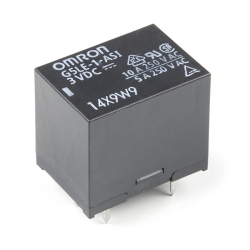
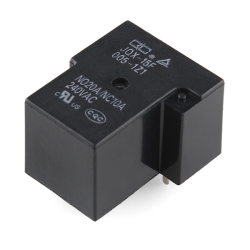
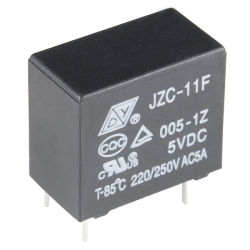
Relay SPDT Sealed

sku: COM-00100 RoHS Compliant

Description: These are high quality Single Pole - Double Throw (SPDT) sealed relays. Use them to switch high voltage, and/or high current devices.

This relay's coil is rated up to 12V, with a minimum switching voltage of 5V. The contacts are rated up to 5A (@250VAC, 30VDC).

Features:

  • 5V DC SPDT Relay
  • Rated up to 5A
  • Fully Sealed

Documents:

Pricing

In stock

1.95
1.76
1.56

939 in stock

price
10+ units
100+ units


Add to Wish List


Comments 30 comments

  • Any plans to get 3V DC coil relays, like the G6RL from the same company?
    Most of the microcontrollers now run at 3.3V and it’s always a pain to interface with 5V…

  • I completely agree with ARMinator. It would be VERY useful to have the 3V version of this relay. Very much hope you start selling it.

  • I may be wrong since I’ve never used relays before, but if you look at the datasheet the amperage required to turn on the relay goes up with lower voltage. for 5v the current is 80ma and would be likely as much as 100ma for a 3.3v relay. That much current will fry most any microcontroller pins, especially low power 3.3v devices. You need to use a transistor or mosfet to source enough current. The voltage on the relay input is then pretty immaterial.

    • I have this working with my LilyPad Arduino, which runs around 3V. As the controllable mains tutorial says, though, you can’t (at least with a LilyPad) control it directly off a microcontroller pin (though happily it didn’t fry mine trying; just didn’t switch). Instead, use a transistor to switch the + supply.

  • Since this relay has 2 connection possibility is the connection determined by the polarity of the current going to the coil? or is one of the connections nc and the other no until current is applied ?

  • vince086: Since this relay has 2 connection possibility is the connection determined by the polarity of the current going to the coil? or is one of the connections nc and the other no until current is applied ?
    One of the contacts is normally closed and the other normally open. The contacts switch when current flows through the coil.

  • I’ve ordered a couple of these for switching equipment with a 5V MCU, and I see now that the data sheet says the “Pick up voltage” is 9VDC – can anyone confirm that these will switch on 5VDC?
    Also, the datasheet’s pinout is different from what appears in the SparkFun Eagle library as COM-00100 (RELAY-2G5Q). You need to use RELAYPTH instead.

    • Hi,
      Thanks for checking on this. The data sheet is a generic data sheet for these relays. The information in that document is intended for a 9V relay. The information can be calculated to find the ratings of a 5V relay, but this unit has been tested at 5V, and as the datasheet points out, it can run down to 75% of the Nominal Voltage, so you can actually run this relay down to voltages as low as 3.7V

  • I’ve also been having some trouble with the Eagle library – none of the pinouts or footprints in the library match what I received in my order.
    They work like a charm, but I’m glad I breadboarded it before I sent for the PCB…

    • Yup, I had to modify the RELAYPTH part after I received the relays an saw the actual pin arrangement.
      If anyone at SparkFun is interested, I can email you the corrected layout for your library.

      • email us at techsupport@sparkfun.com and we can get this fixed. thanks!

        • Has this been fixed? I just ordered 10 of these and I am hoping the SF library is updated…

      • Wesley: _Yup, I had to modify the RELAYPTH part after I received the relays an saw the actual pin arrangement.


        If anyone at SparkFun is interested, I can email you the corrected layout for your library._


        @Wesley: Would you be willing to share your update to the RELAYPATH part with the general public? I find myself in a similar position trying to layout a group of these relays…


        The latest update of the Spark Library I have is from 13 April 2010. Or maybe there is a newer release that includes Wesley’s update?

        • The sparkfun library has moved. It’s now here:
          https://github.com/sparkfun/SparkFun-Eagle-Library

  • So I can connect 110v house power to the poles on this little thing?? Any suggestions for connectors, as the pins on this thing are tiny and standard home wiring isn’t.

    • yup, you can connect mains to it
      a spade connector from home depot or radio shack might work well

  • I found the correct spec sheet with the correct dimensions. http://www.cndongya.com/en/JZC-11F/61.html
    Going to try to modify the part to match these dimensions.
    I’m making a relay board with 10 of these so it’s kinda important that everything lines up.
    Sparkfun, you dont have that many parts… can you double check your datasheets before posting them and making eagle parts?

  • I ordered this but received an omron g5sb14, which is actually a better relay, so pretty happy with the mixup.

    • The pinout is different. Spec sheet:
      http://www.components.omron.com/components/web/PDFLIB.nsf/0/E2085D82177B3E7E85257201007DD57A/$file/G5SB_0609.pdf

  • I can confirm this relay works driven directly from a 5V Arduino digital output. However, it shouldn’t, given that the Arduino Uno max current per pin is 40mA. According to the relay’s actual datasheet, the coil dissipation is 0.72W and has a resistance of 35 ohms. In theory at 5V it should require 143mA, right? But it works.

    Update: that datasheet link now gone, this is the URL now, but it still has incorrect photo.

    • hm, the manufacturer’s entire website is basically broken, so you can’t see the datasheet at the moment. but i thought it was quite different from the sparkfun one, which shows a coil resistance of 320 ohms. if that were the case, it would need only 16mA. when i have time, i’ll go back and actually measure the coil resistance and the current it’s drawing…

  • Alright so I’m very new to relays and I’m hoping someone can help me… What I’m trying to do is use an Arduino Duemilenova to fire an Airsoft gun.. The gun needs 7.2v to fire, so is this what I want to use with the Arduino and an external power supply? Any help would be much appreciated, Thanks :)

    P.S. The battery is 7.2v 400mAh

    • I think no. Is it 7.2V DC? These relays are meant for using a DC power to essentially act as a switch for AC power. you’re looking for a transistor, which allows you to use a lower dc voltage in order to “switch on” a higher dc voltage.

  • Anyone know where to find the correct datasheet, The one on sparkfun is for the 12v version and They only show the 12v one on the manufacturer’s website. And searching google has come up in vain

  • Update: I had previously reported success operating this relay at 5V directly from Arduino digital out. I finally measured its coil resistance, it is 57 ohms, therefore it should need 88mA @ 5V to turn on consistently. However, I can confirm again that it works fine without a transistor, and I measure 55mA going through coil directly from Arduino pin. Since max (for Uno) is supposedly 40mA, not sure how this is happening, but it works. :–)

  • I bought this relay a few weeks ago. The SparkFun Eagle Library part that matched was:
    Device: RELAYPTH4 | Package: RELAY-JZC
    I can’t guarantee that it will be the same for you. My advice: buy the relay before you order your PCB. That way, you can print out a copy of the board and poke the relay pins through the footprint you chose. That way, you can verify that you are using the right footprint.