 Hookup Guide
 Schematic
 Datasheet (STCC4)
Product Overview
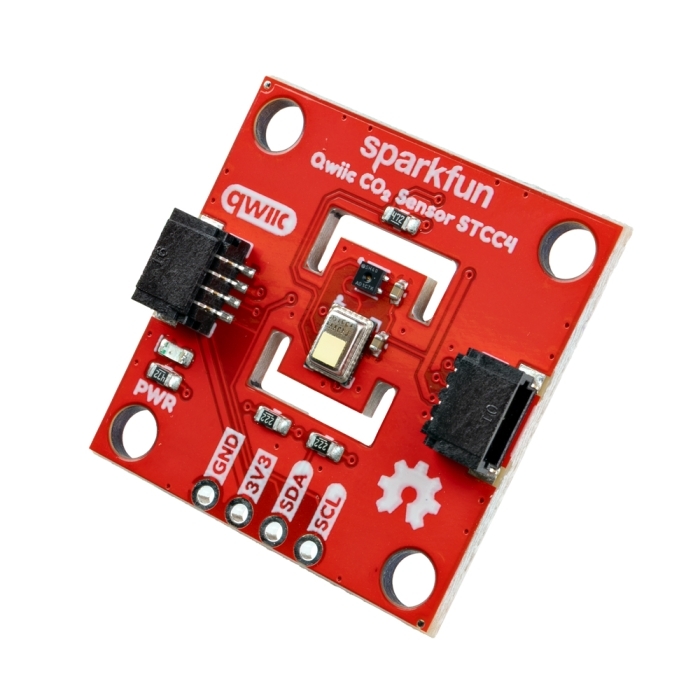
The SparkFun STCC4/SHT40 Qwiic CO2 Sensor is a simple indoor air quality breakout that primarily measures CO2 concentration, as well as temperature and relative humidity, over I2C. Specifically, the board features a pair of Sensirion sensors, isolated in their own section: the STCC4 CO2 sensor and the SHT40 digital temperature and humidity sensor. These two sensors work together to output precise and environmentally compensated CO2 readings without any complicated wiring.
Dual-Sensor Package
To provide the most accurate readings possible, this board integrates two specialized Sensirion components that work together seamlessly over I2C:
- STCC4 CO2 Sensor: While most CO2 sensors measure estimated CO2 concentration, the STCC4 uses thermal conductivity (TC) to directly measure actual CO2 concentrations from 400 to 5000 ppm (parts per million) with an accuracy of ±100ppm + 10% of the total reading. It outputs a calibrated digital signal that works with temperature and humidity data sent to it by the SHT40.
- SHT40 Temperature and Humidity Sensor: The SHT40 is a highly accurate, low-power temperature and humidity sensor that measures temperature with ±0.2°C accuracy across -40 to +125°C. It measures humidity with ±1.8% relative humidity (RH) accuracy from 0 to 100% RH. The sensor consumes very little power, with a max current draw of 500µA during measurements and a typical draw of 0.08µA while the sensor's internal heater is off. With the heater on, current draw increases significantly, up to a max of 100mA.
Since this is an I2C device with a combo of sensors, we'll be working with a few addresses. The STCC4 actually has two I2C addresses configurable by adjusting the ADDR jumper on the back of the board. The default address is 0x64 with an alternate address of 0x65. Meanwhile, the SHT40 connects to the STCC4's I2C pins to provide temperature and humidity compensation data, but it has its own I2C address of 0x44.
Calibration and Integration
Maintaining accurate CO2 measurements over long periods can be challenging, but the STCC4 simplifies the process using an automatic self-calibration (ASC) algorithm. This keeps your readings stable over time with minimal maintenance. The algorithm assumes the sensor is exposed to fresh air that contains a CO2 concentration of at least 400 ppm once a week. This algorithm requires an initial operation period of 12 hours for the sensor to achieve the sensor's measurement accuracy. After this initial period, the sensor stores the first calibration state for subsequent power cycles. If you power down the sensor for more than three hours after initial calibration, run it for an hour to restore measurement accuracy.
For hardware connections, dual Qwiic connectors offer a simple, daisy-chainable I2C interface to your main system. For a more permanent setup, a standard 0.1-inch spaced plated through-hole (PTH) header breaks out the power and I2C pins for users who prefer a soldered connection.