Hookup Guide
 Schematic
 Datasheet (BMI270)
Product Overview
The SparkFun BMI270 6DoF IMU Qwiic Micro Breakout delivers highly precise acceleration and angular-rate measurements, plus a sophisticated on-chip motion-interrupt engine, for optimized motion tracking in an ultra-low-power wearable package. Operating efficiently at both 1.8V and 3.3V, this 16-bit sensor from Bosch Sensortec handles complex tasks like gesture detection and step counting internally, freeing up your microcontroller for other operations while integrating effortlessly into your system via solderless Qwiic connectors.
Intelligent Motion Tracking on a Micro Footprint
The reason why we really like the BMI270 is primarily thanks to its integrated smart features and measuring capabilities, both of which are typically found in smartwatches, fitness trackers, augmented/virtual reality glasses, and more. The BMI270 breakout processes the data it collects all the while actively monitoring for specific physical events.
- Built-in Detection: Uses pre-loaded smart algorithms for any-motion detection, no-motion detection, activity change recognition, wrist-wear wake-up, plug-and-play step counting, and wrist gesture recognition.
- Selectable Ranges: Includes a 16-bit 3-axis accelerometer with four configurable measurement ranges of ±2g, ±4g, ±8g, and ±16g, alongside a 16-bit 3-axis gyroscope with five configurable measurement ranges of ±125dps, ±250dps, ±500dps, ±1000dps, and ±2000dps.
- Hardware Interface: Provides a 400kHz AUX sensor interface with hardware synchronization to easily pull data from secondary peripherals.
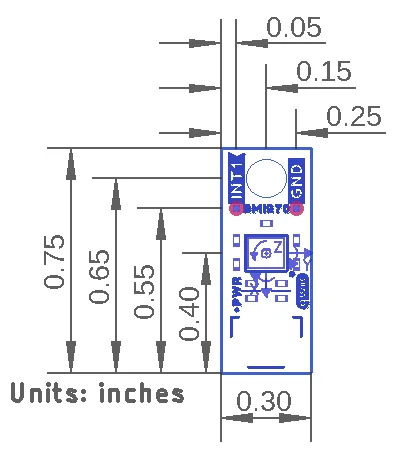
Size and weight are often the biggest constraints in custom electronics that require an IMU, so we took the standard Qwiic BMI270 breakout's low-power motion measurements and engineered them into an incredibly compact board! Our micro-sized 0.3in. x 0.75in. footprint makes this board an ideal option for your smallest projects using our solderless Qwiic cables and compatible controllers. The SparkFun Micro 6DoF IMU delivers the exact same capabilities as its larger sibling, but it is purpose-built for tight enclosures and miniature hardware setups.
The breakout communicates natively over I2C (defaulting to address 0x68) using a single horizontal Qwiic connector on the micro footprint (just keep in mind that this board will need to be at the end of a daisy-chain). Due to its size, we've only provided 0.1-inch-spaced pins for GND and INT. On-board solder jumpers on the back of the board still allow you to change the I2C address, remove the pull-up resistors, or disable the power LED.