Hookup Guide
 Schematic
 Datasheet (TMF882X)
 Driver User Guide (TMF882X)
Product Overview
The SparkFun Qwiic TMF8820 dToF Imager lets your projects detect distances up to 5000mm (or 16.4ft.) using advanced direct time-of-flight technology, even in challenging lighting conditions. Whether you're building collision-avoidance systems for robotics or presence-detection networks, this standard 1-inch by 1-inch Qwiic-enabled breakout simplifies the math by processing histogram data on the chip and sending the results over I2C to your microcontroller.
If you're looking for a smaller footprint or a board that weighs a little less than this one, check out our Qwiic Mini dToF TMF8820 Imager board!
Multizone Distance Tracking
Accurately measuring distance in bright environments often confuses standard optical sensors. The TMF8820 module on this board bypasses that limitation by including a single modular package with an associated Vertical Cavity Surface Emitting Laser (VCSEL) from AMS. The dToF device uses a Single Photon Avalanche Photodiode (SPAD), a time-to-digital converter (TDC), and histogram technology to achieve that 10mm to 5000mm detection range. Due to its lens on the SPAD, it supports 3x3 multi-zone output data and a very wide, dynamically adjustable field of view. A multi-lens array (MLA) inside the package above the VCSEL widens the FoI (field of illumination).
Solderless I2C Integration
To keep your prototyping process fast and efficient, all raw data processing happens directly on the sensor itself. The board outputs accurate distance information alongside confidence values over a standard I2C interface running at up to 30Hz:
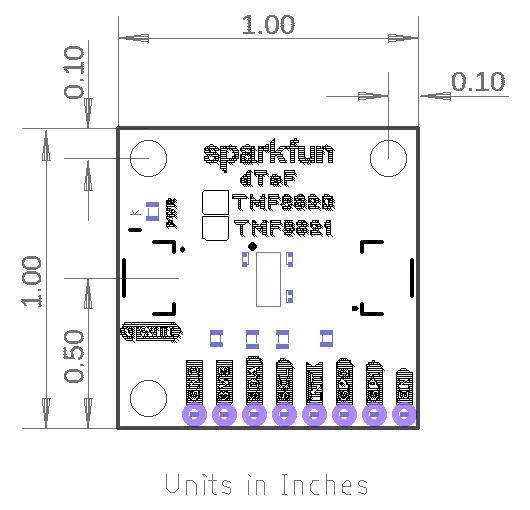
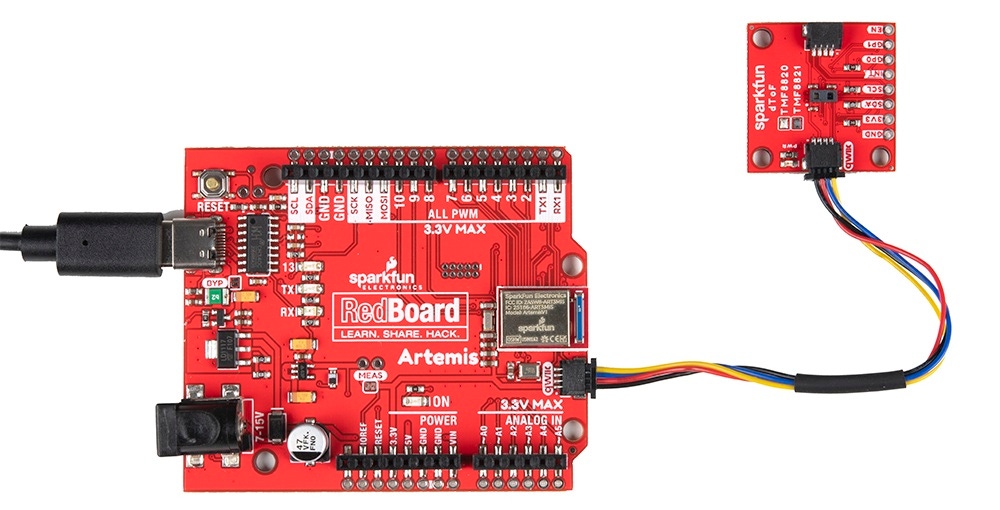
- Qwiic Connectivity: Dual onboard Qwiic connectors let you daisy-chain the imager without soldering, and standard 0.1-inch spaced pins are broken out for traditional breadboard layouts.
- Hardware Control: Includes two configurable GPIO pins and one enable (
EN) pin for direct hardware triggers. - Customizable Layout: The power
LEDandI2Cpull-up resistors can be easily configured or disabled via onboard solder jumpers. - Low Power Draw: Consumes just 57mA while active and drops to an incredibly efficient 8µA in standby mode.
If you want to skip the programming entirely, this breakout is fully compatible with the DataLogger IoT system! When connected, the TMF8820 sensor is automatically detected, scanned, configured, and logged. This allows you to start gathering time-of-flight data immediately! No programming, soldering, or complex setup required.
One thing to keep in mind before picking up this dToF Imager: we recommend a microcontroller with sufficient flash to run your program. Sorry, Unos (or any development board using the ATmega328P) are out. We recommend choosing an Artemis Thing Plus, an ESP32 Thing Plus, or a comparable device as your development board.
This sensor is great for more advanced projects, such as mobile laser autofocus, industrial light curtains, and drone navigation.