Hookup Guide
 Schematic
 Datasheet (G6K-2F-Y DC3)
Product Overview
Easily control high-power devices directly from your microcontroller via I2C with the SparkFun Qwiic Relay. Built around the Omron G6K-2F-Y DC3 dual-pole/dual-throw (DPDT) relay, this board allows you to safely switch loads up to 1A at 30VDC or 0.3A at 125VAC (at 40°C). This relay is perfect if you're controlling heavy-duty motors or managing other high-power devices, bridging the gap between low-voltage logic and high-power applications.
Flexible Control Options
We designed this board to adapt to your specific project needs, offering multiple ways to trigger the relay:
- I2C Drive: Controlled via the on-board TCA9555 GPIO expander, requiring a remarkably low drive current of just 5.8mA at 3.3V.
- External Drive: This relay can also be triggered by an external input, such as a physical switch or a standard I/O signal (up to 50mA), giving you hardware-level control.
- Solderless Qwiic Integration: Two on-board Qwiic connectors let you add the relay to your I2C daisy chain without ever touching a soldering iron.

Transitioning from a Single Relay
If you are upgrading from our original Qwiic Single Relay, this DPDT version introduces a few key architectural differences that have been tailored for precision control:
- Dual-Circuit Control: While the original relay used a single-pole (SPDT) design, this DPDT board can switch two completely independent circuits simultaneously with a single command.
- Signal Optimized: The original relay was primarily built for heavy, high-voltage AC loads up to 5.5A at 240VAC. This new DPDT version is specifically engineered for lower-power signal-level switching up to 1A at 30VDC.
- Advanced Drive: Don't want to use I2C? This board allows external devices to drive the relay control directly.
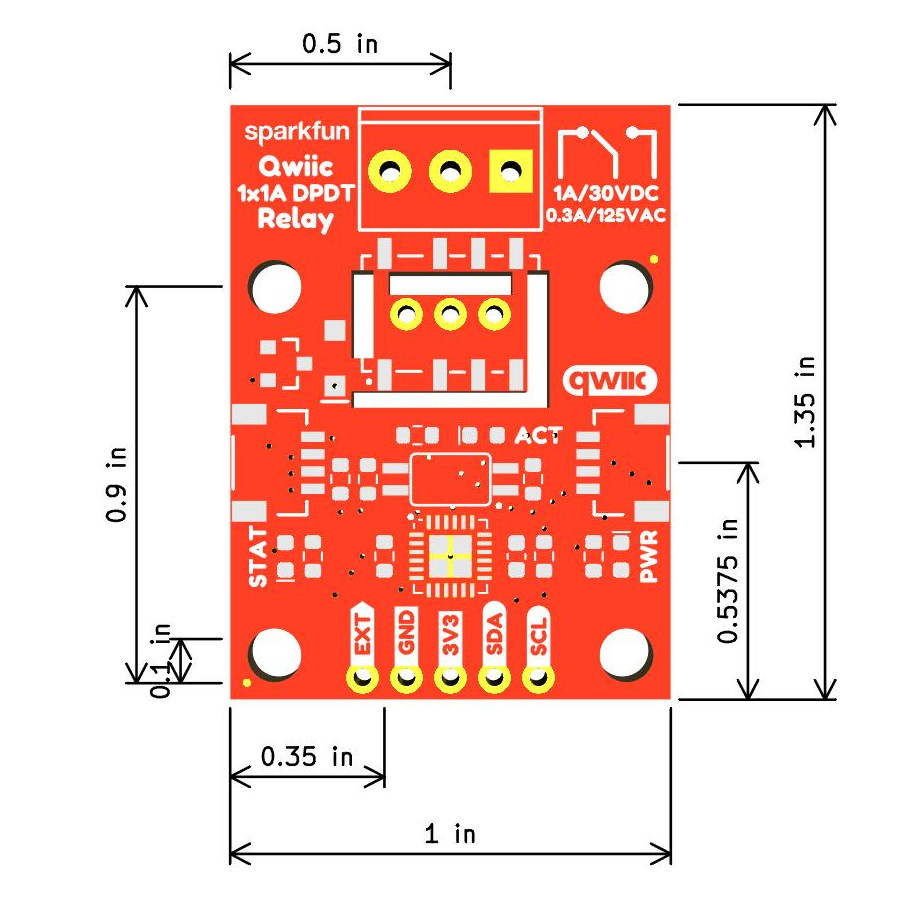
Wiring your high-power components is as straightforward as it gets with the Qwiic Relay. We included a 3-pin screw terminal for a quick, completely solderless connection to the relay's primary pole (COM Pole). Meanwhile, the secondary pole (COM2 Pole) is broken out to standard 0.1-inch-spaced plated-through holes (PTH), giving you the flexibility to solder wires directly or use a breadboard for prototyping.