


 Quick Start Guide
 SiTime SiT5358 Datasheet
 Schematic
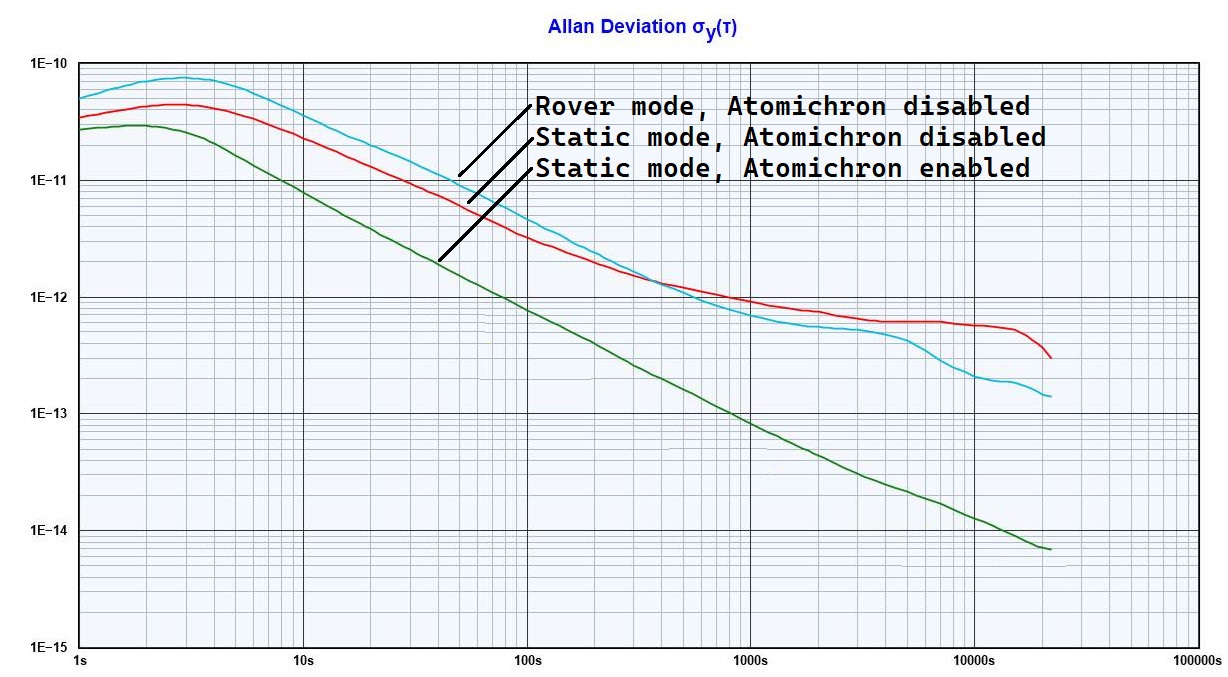 Allan Deviation
Product Overview
Designed and manufactured in Boulder, Colorado, USA, the SparkPNT GNSS Disciplined Oscillator (GNSSDO) is the perfect solution for your high-precision timing and frequency needs. This is our most advanced timing product based on the multi-constellation, multi-frequency, L1/L2/L5-ready mosaic-T from Septentrio.
The Septentrio mosaic-T offers a high-precision solution for time and frequency synchronization under challenging conditions, such as during GNSS jamming or spoofing. It provides unmatched resilience thanks to its all-constellation multi-frequency capabilities and AIM+ technology. Time pulse precision is 5ns, and better than 1 nanosecond with an optional subscription to Fugro AtomiChron®. Event accuracy is better than 20ns. We've paired the mosaic-T with the SiT5358 Super-TCXO from SiTime to provide the best clock frequency stability, accuracy, and holdover during GNSS outage. Are you looking for a very accurate time and frequency solution for your lab or remote equipment? This is it!
Under the hood, the GNSSDO is based on the mosaic-T GNSS module from Septentrio, plus the Espressif ESP32-WROVER processor (16MB flash, 8MB PSRAM). The disciplined 10MHz oscillator is the SiT5358 Super-TCXO from SiTime: ±50ppb stability; ±1ppb/°C frequency slope; ±58ppb typical 20-year aging; with digital control via I²C; the Allan Deviation approaches 1E-14 at 10000 seconds with AtomiChron® enabled. The mosaic-T has USB-C connectivity (with Ethernet-over-USB) and multiple UARTs, and it supports full Ethernet connectivity. You can connect the mosaic-T directly to your Ethernet network - our product supports Power-over-Ethernet too. The ESP32 is there to discipline the TCXO and control the OLED display. Remote configuration is easy, thanks to your access to the internal ESP32 serial console via TCP.
We've designed the GNSSDO to be robust and deployable. Internally, all electronics (except the Qwiic OLED display) are mounted on a single circuit board. The mosaic-T GNSS antenna, Pulse-Per-Second output, disciplined 10MHz output, and EventA input are all connected via SMA connectors. If desired, the 10MHz SMA can also be configured as an input, allowing you to use your own TCXO. IO connections are made via a 3.5mm header with cage screw connections. The IO voltage is selectable between 3.3V and 5V. The Reset and Log switches have been positioned carefully; Log is easily clicked when required, and Reset is flush and needs a more assertive press. The edge of the microSD card protrudes slightly when inserted, making it easy to eject and re-insert. Then there is the beautiful custom extruded aluminum case with machined end panels and slotted flanges, making it simple to install the GNSSDO in a weatherproof enclosure up on the roof or in your server rack.
The included antenna has been certified by the National Geodetic Survey. The ANTEX and ANTINFO are available. The full listing under SFESPK6618H is on the NGS Antenna Calibrations website. AtomiChron® service is delivered over-the-air using the same GNSS antenna that is provided with the kit, no internet access is required.
The GNSSDO has multiple power options. Any or all of these can power it: the mosaic-T USB-C connection, the ESP32 USB-C connection, Power-over-Ethernet (36V to 57V), or an external DC power source between 9V and 36V. The GNSS SMA antenna connection provides 3.3V for the included active L1/L2/L5 antenna.
Our kit includes everything you need to get up and running. Please see the 'Includes' tab for more information.


